
William Cameron Menzies’ Invaders From Mars would end up being the penultimate film in one of Hollywood’s most important and longest careers. Menzies found his path into Hollywood by bullshitting his way onto the production of Douglas Fairbanks’ The Thief of Baghad (he was later an uncredited co-director on the Michael Powell version). While he’s not that well-known today, Menzies was one of the most important filmmakers of all time, because he essentially invented the concept of a production designer. He originated the role and continued to work as a production designer off and on afterwards, working with Hitchcock, Capra, and on films like Gone With the Wind, where he directed the burning of Atlanta sequence. He became a director in 1930, and his best-known film is the dystopian Things to Come, for which he was also the production designer.
Invaders From Mars was a science fiction film made at the height of the cold war. It was a quickie—Independent National Pictures Corp. wanted a colour science-fiction picture to cash in on the upcoming release of Paramount’s bid-budget War of the Worlds. The result was an almost Alice in Wonderland-esque science-fiction tale in which a young boy, David McLean (Jimmy Hunt), discovers that space aliens are taking over the minds of the people in his small town. The theme predates Invasion of the Body Snatchers, which came out a few years later. David’s father leaves the house to investigate his son’s claim of a flying saucer and comes back strangely changed, and then the same thing happens to others. Will he be able to convince the grown-ups that the alien invasion is real and not a figment of his imagination?
Helena Carter, in her final screen role, plays health-department physician Dr. Pat Blake who believes his story, and is photographed in a deliberately angelic fashion. The white dress she wears is a striking contrast to the blues and greens that backdrop the film.
1953 was quite a year for anti-authoritarian films about child protagonists, with this release and 5,000 Fingers of Dr. T. Both films taught a younger generation to be distrustful of authority figures. In the documentary on the UHD disc, Joe Dante even goes as far as to say that without films like Invaders From Mars, the counter-culture of the ’60s wouldn’t have happened.
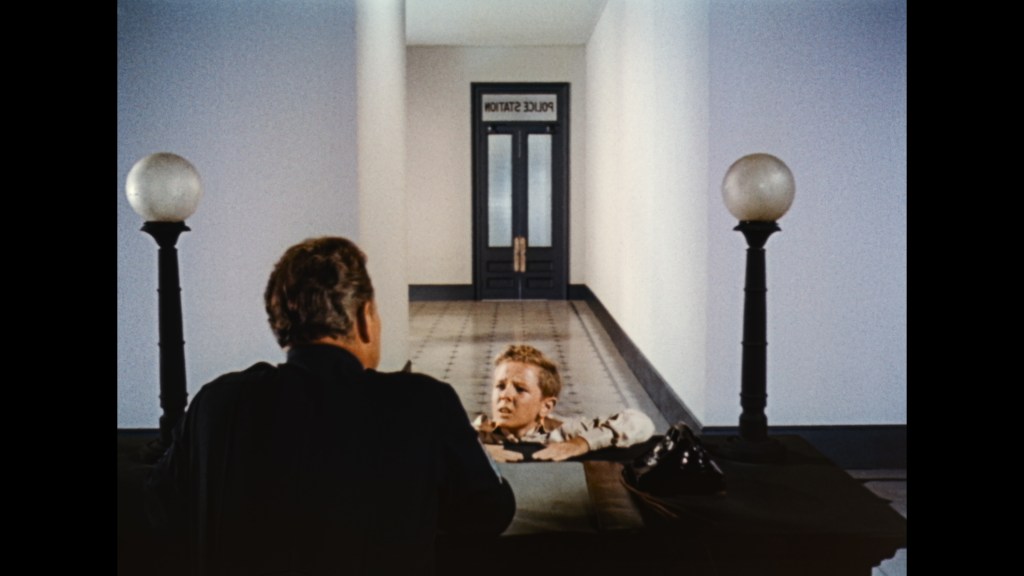
Menzies was working with a small-budget —under $300,000, which even back then was not a lot of money, especially for an ambitious science-fiction film. It’s around the same amount that Things to Come cost back in the ’30s, and that was an “A” picture. The film has a very vivid and quite surreal atmosphere through, largely due to Menzies’ German expressionism-meets-Norman Rockwell production design. There has been a lot of debate over whether it had been shot to be 3D or not, since it came out at the height of the 3D craze but was never released in 3D. The film they used was a three-color process known as Cinecolor, which combined with Menzies’ out of this world production design is what creates the film’s striking use of colours. It was one of the last films released in this process.
It’s all told through the point of view of the child, which is what makes it dreamlike. In a way, it’s a kind of sci-fi twist on Nicolas Ray’s Bigger Than Life, and you could even compare it to a Douglas Sirk film, with its focus on the underbelly of America. However, the 76-minute film has been padded out with a lot of stock footage of tanks and stuff to make it longer than the material that Menzies actually shot. The one mistake of the film in my view is the twist ending, but the whole “it was all a dream—or was it?” wasn’t quite the cliche it has become with 70 years of cinema since its release.
Invaders from Mars is one of the best science fiction films of its era, and perhaps in retrospect is the most influential. It paved the way for all the alien-invasion and body-swap films that came in its wake. It’s also one of the most beautifully designed films of its type for the era, I would even say that some of the big hitters of the film world aren’t as beautifully designed as Invaders from Mars. The Martians themselves may leave something to be desired, as the’re clearly humans in green furry suits: I think you can even see a zipper or two down the back. The striking image of the Martian mastermind in the glass bubble is something you could imagine H.P. Lovecraft would get from of his nightmares with its tentacles. Luce Potter, who was also an uncredited munchkin in The Wizard of Oz, plays the being and would get fan letters from people thanking her for giving them nightmares as kids.
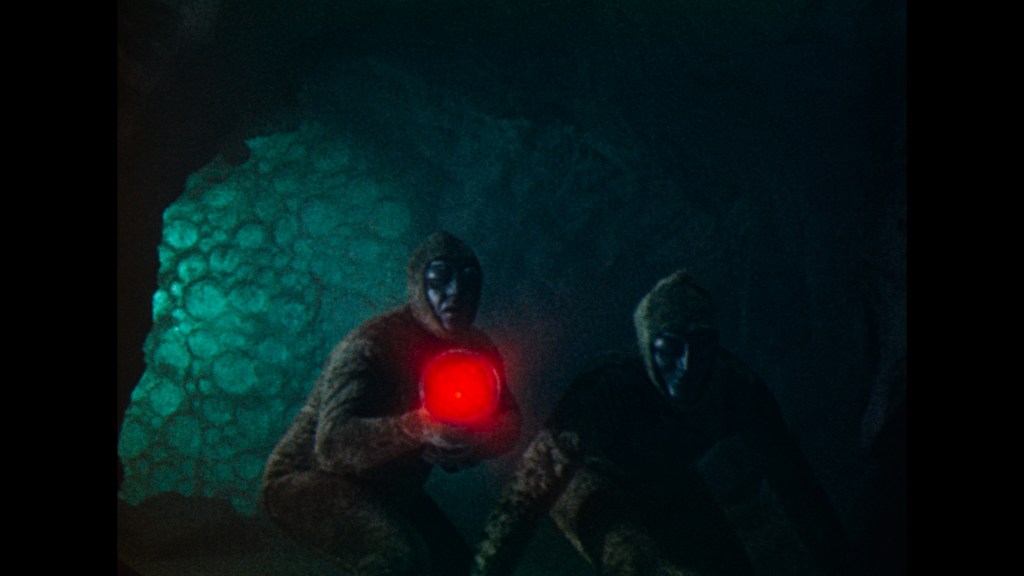
The UHD 4K restoration is one of the best I’ve seen of a classic Hollywood film. The colours are so vibrant and just jump out of the screen. It’s a truly breathtaking restoration, especially if you’ve seen the film only previously on really shoddy “public domain” copies. The extras on the disc are solid, with an interview with Menzies’ biographer, James Curtis, and his granddaughter, Pamela Lauesen. The film’s Jimmy Hunt, who is now 83, gives an entertaining interview about his experience of making the film. There is a solid documentary on the film, even if it’s a little on the short side at 22 minute, which features interviews with Joe Dante, John Landis, editor Mark Goldblatt, and special effects legend and Invaders from Mars superfan Robert Skotak, plus Scott MacQueen, who did the restoration. John Sayles supplies an introduction for TCM, where the restoration premiered. Scott MacQueen does a before and after of the restoration, and the alternative international ending and extended Planetarium scene are included as extras on the disc along with an extensive photo gallery. MacQueen pens an extensive essay on his restoration in the booklet that comes with the UHD.
★★★★
Ian Schultz

 psychotroniccinema.com